How has artificial intelligence changed the way auctions work?
Previously, the marketer had direct control over:
Bids
Keywords
Ad display timing
Today, artificial intelligence systems do:
Automatically adjust bids (Smart Bidding)
Choose the appropriate audience
Determine the best time and place to display the ad
Improve performance based on real-time data
This means that a large part of the control is in the hands of the system, not the marketer.
The problem: Traditional metrics are no longer sufficient
In an AI-driven environment, indicators such as:
Cost per click (CPC)
Click through rate (CTR)
Number of appearances
Sufficient to accurately evaluate performance.
Why?
Because these metrics do not reflect...Real value What a campaign achieves, especially when AI is making the decisions.
What should be measured instead?
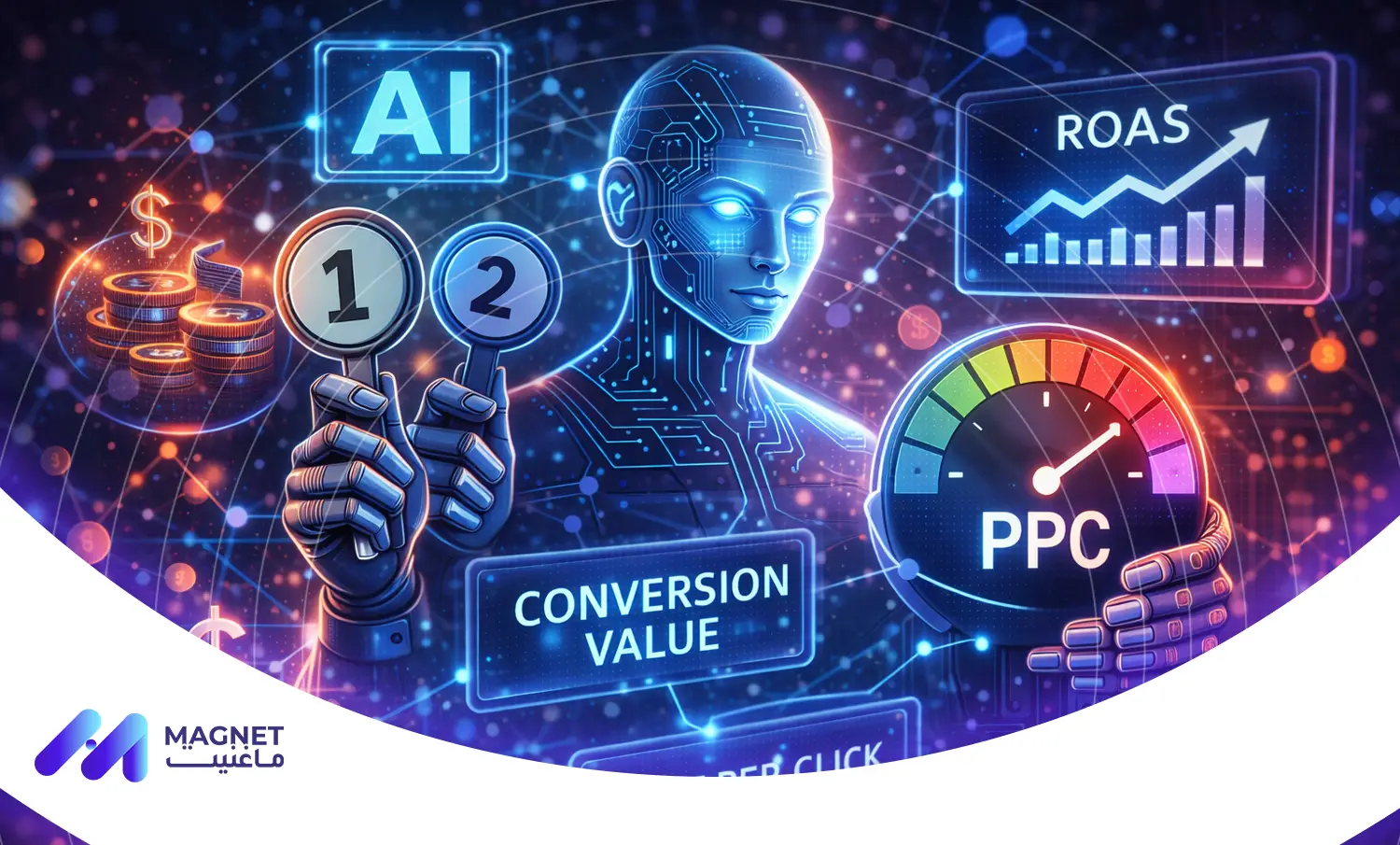
1. Conversion Value
Instead of focusing on the number of conversions only, you should focus on...The value of each transfer.
Not every customer is equal — some customers are more valuable than others.
2. Return on Advertising Spend (ROAS)
ROAS is one of the most important indicators in an AI environment, because it measures the relationship between:
What you spend
And the return you achieve
3. Data Quality
AI is data-driven — if the data is poor, the results will be poor.
Therefore you must make sure:
Accurate conversion tracking
The validity of the entered data
Complete customer information
4. Audience Signals
Intelligent systems rely on audience signals to understand who to target.
The more accurate these signals are, the better the results.
How do you deal with campaigns run by artificial intelligence?
✔ Give the system time to learn
Intelligent systems need time to analyze data and improve performance.
Constant changes may disrupt the learning process.
✔ Focus on strategy, not details
Instead of trying to control every element, focus on:
Setting goals
Choose the appropriate strategy
Data optimization
✔ Do not rely on a single indicator
Performance measurement must be comprehensive, not based on just one number.
✔ Test, but smart
Experiments are important, but they must be deliberate, not random.
Has the marketer lost control?
Not quite.
Control has not disappeared, but...Move from implementation to direction.
Instead of controlling every click, the marketer's role is to:
Determine the direction
Improve input
Analyze the results
What does this mean for the future of PPC?
We move from:
Manual management → intelligent management
Direct control → strategic direction
Human decisions → to data-backed decisions
This requires new skills, such as:
Understanding data
Performance analysis
Build smart strategies
Conclusion
In a world where AI controls auctions, success in PPC no longer depends on manual control, but on:
Data quality
Clarity of goals
Ability to read results
The successful marketer today is not the one who runs the campaign, but rather the one who understands how the algorithm works and leads it towards the desired results.