Electronic marketing tools and their types
come Electronic marketing tools With a variety of features that meet the needs of different companies, from startups to large enterprises. These tools can be divided into several categories including:
Social media management tools
Search Engine Optimization (SEO) Tools
Email marketing tools
Advertising campaign management tools
Analysis and reporting tools
These tools are available in various pricing plans, ranging from free subscriptions that provide basic features, to paid subscriptions that offer advanced capabilities such as integration with other platforms, the ability to customize reports, and dedicated customer support. This variety of pricing plans makes it easy for businesses to choose tools that fit their budget and marketing needs.
E-marketing tools in social media
Social media marketing tools play a vital role in facilitating and improving the management of marketing campaigns on various social media platforms. These tools allow marketers to perform a wide range of tasks that contribute to achieving marketing goals and increasing interaction with the audience. Below is a breakdown of the most important tasks performed by social media marketing tools:
1.Schedule posts
Perfect timing: The tools allow posts to be scheduled to be published at times that are most convenient for the target audience, increasing the chances of them being seen and interacted with.
Multi-channel management: It allows scheduling posts across multiple platforms such as Facebook, Twitter, Instagram, LinkedIn and other social media platforms.
2.Content management
Content organization: The tools help organize planned content and content that has already been published, making it easier to track and manage the campaign.
Media library: Provides a central library for storing and managing photos, videos, and other files used in publications.
3.Performance analysis
Interactive reports: Social media tools provide detailed analytical reports on the performance of posts, such as the number of likes, comments, shares, and clicks.
Growth metrics: It helps track follower growth and analyze audience engagement over time.
4.Interact with the public
Automatic replies: Some tools allow setting up automatic responses to comments and messages, which contributes to improving response speed and increasing engagement.
Interaction management: It helps monitor and respond to comments and private messages effectively, improving customer experience and enhancing brand loyalty.
5.Monitor the brand and competitors
Brand monitoring: It provides the ability to monitor mentions of the brand across various platforms, which helps in understanding how the audience talks about the brand.
Competitor analysis: It allows monitoring competitors' performance and analyzing their strategies, which helps identify opportunities and threats in the market.
6.Advertising management
Create ads: The tools help create and manage sponsored social media campaigns, including setting a budget and choosing a target audience.
Advertising performance analysis: Provides detailed analytics on the performance of sponsored ads, such as click-through rates and conversions.
7.Integration with other tools
Data synchronization: It allows data to be integrated with other marketing tools such as email and customer relationship management (CRM) tools, enabling comprehensive visibility and integrated analysis.
Campaign integration: Contributes to coordinating campaigns across multiple channels, enhancing the integration of digital marketing strategies.
8.Managing teams and projects
Team Collaboration: Social media tools provide team collaboration capabilities, allowing multiple teams to work together in a coordinated and effective manner.
Task tracking: It allows you to assign tasks and track their progress, which helps ensure that goals are achieved on time.
1- Hootsuite
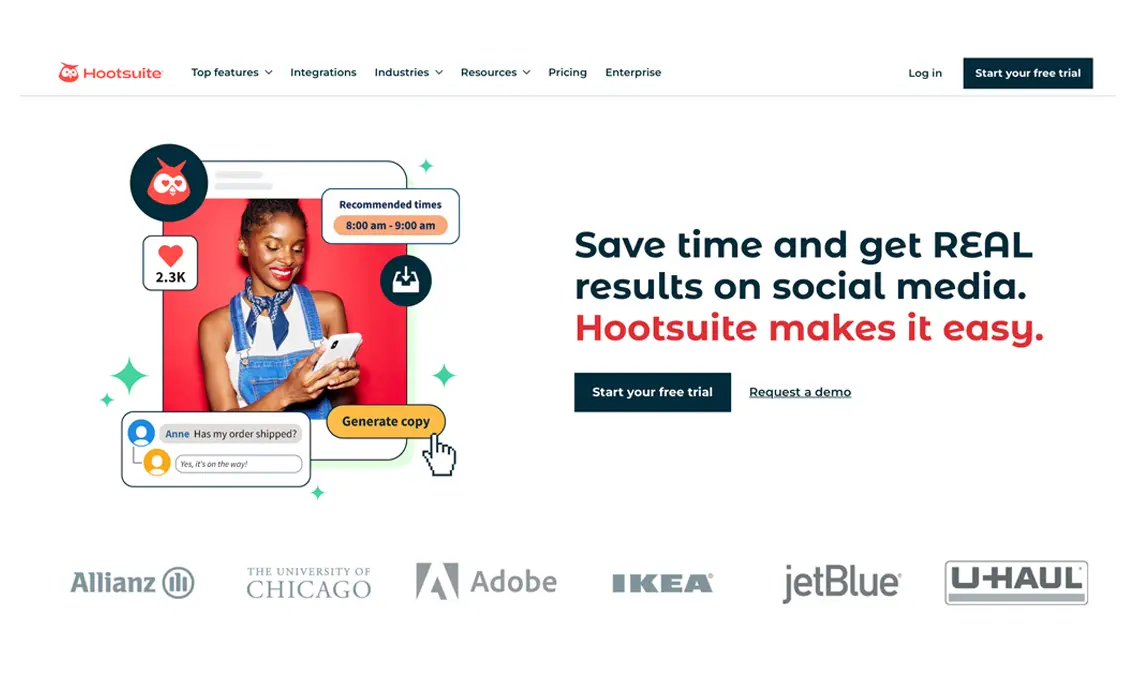
Hootsuite It is one of the most popular social media management tools in the world. Some statistics and numbers that highlight Hootsuite's position in the market include:
User base: Hootsuite has more than 18 million users worldwide.
Customers: Its client base includes more than 800 Fortune 1000 companies.
Languages: Hootsuite supports social media management in more than 35 languages.
Publishing Through the Hootsuite platform, millions of posts are published monthly on various social media platforms.
Partnerships Hootsuite has partnerships with major platforms like Facebook, Twitter, LinkedIn, and Instagram, enhancing their integration and ease of use.
Hootsuite Advantages
1.Schedule posts
Integrated management: It allows scheduling posts on various social media platforms from one place.
Perfect timing: Provides recommendations for the best times to post based on analysis of audience activity.
2.Performance analysis
Detailed reports: Provides comprehensive analytical reports on the performance of publications and interaction with the audience.
Monitor trends: It helps in monitoring trends and analyzing audience behavior over time.
3.Team management
Cooperation and coordination: Provides tools to coordinate work among team members, making it easier to manage campaigns collectively.
Role management: Allows you to assign different roles and powers to team members to ensure organization and efficiency.
4.Brand monitoring
Monitor signals: Mentions of the brand can be monitored across various platforms, which helps in quickly responding to comments and discussions.
Competitor analysis: Provides tools to monitor and analyze competitors' performance on social media.
5.Multiple integrations
Integrate with other tools: Integrates with many other marketing tools such as Google Analytics and Mailchimp, providing comprehensive visibility and integrated analysis.
Application programming interfaces (APIs): Allows integration with companies' internal systems to enhance management and analysis capabilities.
Cons of Hootsuite
1.Cost
Paid plans: Paid plans are a bit expensive for small businesses or individuals, as they require a budget that can be relatively high.
Limited free plans: The free plan offers very limited features, forcing users to upgrade to take advantage of the full features.
2.User interface
Interface complexity: Some may find the user interface complicated at first and requires time to learn and adapt to.
Frequent updates: Frequent updates can be confusing for users who are accustomed to a particular interface.
3.Integration with platforms
Integration constraints: Although there are many integrations, some integrations with other platforms may not be seamless or require additional settings.
Connectivity problems: Some companies may have issues connecting to certain platforms or internal tools due to complexities in the APIs.
4.Advanced analytics
Limitations of advanced analytics For businesses that need very advanced analytics, Hootsuite's analytics tools may be insufficient and require additional tools.
2- Buffer

Buffer It is one of the popular social media management tools, used by individuals and companies to organize, schedule and analyze content across various platforms. Here are some statistics and numbers that reflect the reach and impact of Buffer:
User base: Buffer is used by more than 75,000 companies around the world, as well as millions of individuals.
Customers: Its clients include major companies such as Microsoft, Trello, and Shopify.
Supported platforms: Buffer supports publishing on major platforms such as Facebook, Twitter, LinkedIn, Instagram, and Pinterest.
Publishing: Millions of posts are scheduled and published monthly via Buffer.
Advantages of Buffer
1.Schedule posts
Ease of use: The user interface is simple and easy to use, making it easy to schedule posts.
Multi-channel management: It allows scheduling posts on various social media platforms from one place.
2.Performance analysis
Detailed reports: Provides detailed reports on the performance of posts, such as likes, comments, and shares.
Growth metrics: Helps track the growth of the number of followers and engagement with the audience over time.
3.Team management
Cooperation between members: It allows adding team members and coordinating work between them, which makes it easier to manage social accounts collectively.
Roles and powers: Different roles and powers can be assigned to team members to ensure organization and efficiency.
4.Media library
Media organization: Provides a central library for storing and managing photos, videos, and other files that are used in publications.
5.Multiple integrations
Integrate with other tools: Integrates with other marketing tools such as Google Analytics, providing comprehensive visibility and integrated analysis.
Application programming interfaces (APIs): Allows integration with companies' internal systems to enhance management and analysis capabilities.
Cons of Buffer
1.Advanced analytics
Limited analytics: Analytics tools may be limited compared to more advanced tools like Hootsuite and Sprout Social.
Limited reporting: Available reports may not be sufficient for companies that need in-depth analyses.
2.Paid plans
Cost of subscriptions Paid plans may be a bit expensive for small businesses or individuals, especially as their needs grow.
Limited free plans: The free plan offers limited features, forcing users to upgrade to take advantage of the full features.
3.Interaction management
Limited comment management: Tools available for managing interaction with comments and messages may be less comprehensive than other tools.
No automatic response: It lacks some advanced features such as automatic replies to comments and messages.
4.Not supporting some platforms
Platform restrictions: Although it supports many popular platforms, Buffer may not support some other platforms or some advanced features on the supported platforms.
3- Sprout Social
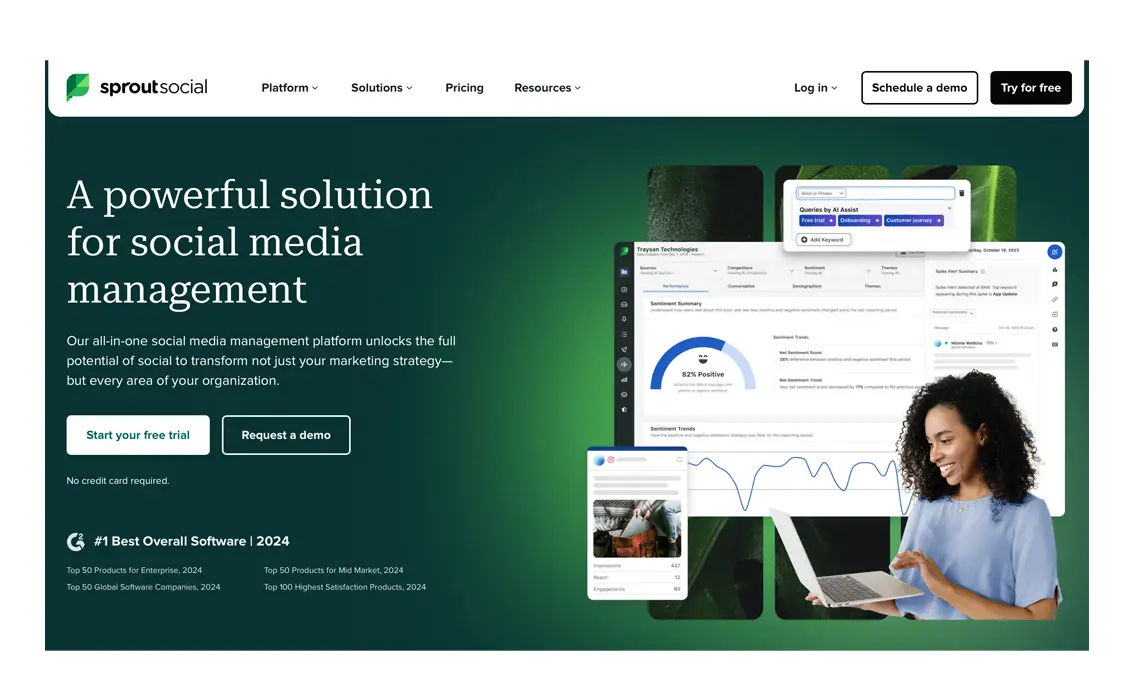
Sprout Social It is one of the most prominent social media management tools, and is widely used by companies and organizations to improve the performance of their campaigns on social media platforms. Here are some statistics and numbers that highlight the impact and spread of Sprout Social:
User base: Sprout Social is used by more than 30,000 companies around the world, including many major brands.
Customers: Among its clients are well-known companies such as Grubhub, Subaru, Make-A-Wish Foundation.
Staff: Sprout Social has over 500 employees working to develop and improve the platform.
Finance The company obtained financing worth more than $111 million to support its growth and develop its services.
Markets: Manages marketing campaigns on multiple platforms including Facebook, Twitter, Instagram, LinkedIn, and Pinterest.
Advantages of Sprout Social
1.Schedule posts
Integrated management: It allows scheduling posts on various social media platforms from one place, saving time and effort.
Timing recommendations: Provides recommendations on the best times to post based on audience behavior analytics.
2.Performance analysis
Detailed reports: Provides comprehensive analytical reports that help measure the performance of publications and interaction with the audience.
Custom dashboards Dashboards can be customized to clearly display important metrics.
3.Interaction management
Unified inbox: It allows managing interactions received from various platforms in one place, making it easier to follow comments and messages.
Track interactions: It helps track all interactions with the audience and analyze them to improve communication strategies.
4.Team management
Cooperation between members: Provides tools to coordinate work among team members and facilitate cooperation between them.
Custom roles and permissions: Different roles and powers can be assigned to team members to ensure organization and efficiency.
5.Brand monitoring
Monitor signals: Helps monitor mentions of the brand across various platforms and analyze reactions.
Competitor analysis: Provides tools to monitor and analyze competitors’ performance on social media.
6.Multiple integrations
Integrate with other tools: Integrates with other marketing tools such as Google Analytics and Salesforce, enhancing analysis and management capabilities.
Application programming interfaces (APIs): Allows integration with companies' internal systems to enhance management and analysis capabilities.
Cons of Sprout Social
1.Cost
Paid plans: Paid plans are more expensive for small businesses or individuals.
Limited free plans: Sprout Social does not offer a free plan, which can be a drawback for startups with limited budgets.
2.User interface
Interface complexity: Some new users may find the user interface complex and takes time to learn and adapt to.
Frequent updates: Frequent updates can be confusing for some users who are accustomed to a particular interface.
3.Limited features
Advanced analytics: Despite providing detailed reports, the tool may lack some of the advanced analytics that larger companies need.
Not supporting some platforms: Sprout Social may not support some emerging platforms or new features quickly enough.
4.Limited integrations
Connectivity problems: Some integrations with other tools may be complex or require additional settings, which can be cumbersome for small businesses.
4- SocialBee
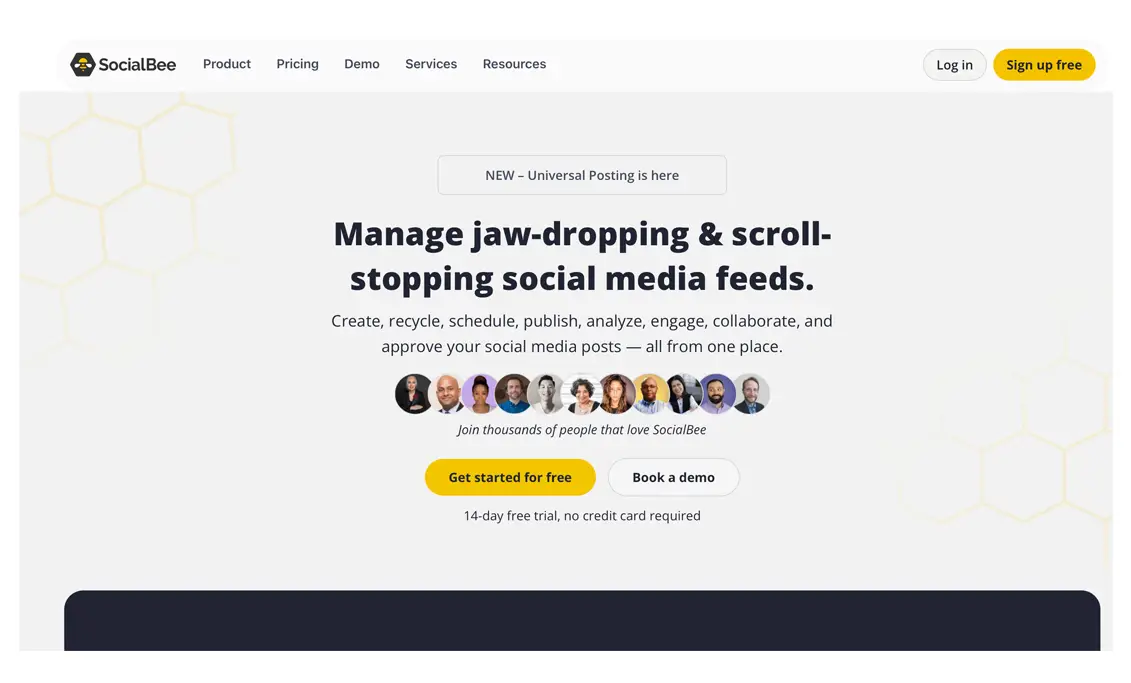
SocialBee It is a social media management tool focused on facilitating the creation, scheduling, and analysis of content across various platforms. Although it's less popular than some of the bigger tools like Hootsuite and Buffer, it has an active user base and offers unique features that meet the needs of small and medium businesses. Here are some statistics and numbers about SocialBee:
User base: SocialBee is used by thousands of small and medium businesses around the world.
Customers: Its client base includes a variety of industries such as digital marketing, consulting, education, and e-commerce.
Integrals: SocialBee integrates with major social media platforms like Facebook, Twitter, LinkedIn, Instagram, and Pinterest, as well as other marketing tools like HubSpot and Zapier.
Finance: SocialBee was developed with limited funding with a focus on self-growth by providing valuable services to its users.
Advantages of SocialBee
1.Schedule posts
Content classification: SocialBee allows content to be categorized into different categories, making it easier to organize and schedule posts in an organized manner.
Automatic repost: Content can be recycled automatically, ensuring continuous content publishing without the need for constant manual scheduling.
2.Performance analysis
Comprehensive reports: SocialBee provides detailed reports on post performance and audience engagement metrics.
Performance monitoring: Users can track follower growth and engagement rates across multiple platforms.
3.Team management
Team collaboration: Provides tools to facilitate collaboration between team members, which helps distribute tasks and manage social accounts effectively.
Custom roles: Different roles and powers can be assigned to team members to ensure organization and effectiveness.
4.Media library
Organize visual content: Provides a central library for storing and managing photos, videos, and other files used in publications.
Seamless integration: Allows integration with other media storage tools, making it easier to use content across platforms.
5.Multi-channel support
Multi-platform management: Supports managing multiple accounts on platforms such as Facebook, Twitter, LinkedIn, Instagram, and Pinterest from one place.
Integration with other marketing tools: Integrates with tools like HubSpot and Zapier to streamline the end-to-end marketing process.
Cons of SocialBee
1.Cost
Paid plans: Paid plans can be relatively expensive for small businesses or individuals looking for economical solutions.
Limitations of the free plan: Offers limited features in the free plan, which users may have to upgrade to take full advantage of the features.
2.User interface
Interface complexity: Some new users may find that the user interface takes time to learn and adapt, despite its relative ease.
Interface design: The interface may look a bit outdated compared to some of the other, more modern tools.
3.Limitations of advanced analytics
Analytics: It may lack some advanced analytical features that are available in other tools like Sprout Social or Hootsuite.
Custom reports: Custom reporting options may be limited compared to other pricier tools.
4.Limited Integrations
Integration problems: Some integrations may be limited or require additional settings, which may be inconvenient for some users.
Availability of features: Some features may not be equally available for all supported platforms.
Email marketing tools
Email marketing It plays a vital role in strategies Digital marketing It helps companies communicate with their audience effectively and efficiently. These tools provide a range of features that make it easier to create, manage, and analyze email campaigns. Here are some of the most prominent email marketing tools and their most important features:
1. Mailchimp
Statistics and numbers:
Used by more than 20 million users.
More than a billion emails are sent every day.
Advantages:
Ready-made templates: Provides an extensive library of customizable templates.
Integration: It integrates with many other tools and platforms such as Shopify, WordPress, and Salesforce.
Analytics: Provides detailed reports on campaign performance such as open rates, clicks, and bounces.
Automation: Supports creating automated email campaigns based on users' behavior.
Cons:
Paid plans: Paid plans can be expensive for small businesses.
Limitations of the free plan: The free plan offers limited features compared to paid plans.
2. Constant Contact
Statistics and numbers:
Used by over 650,000 customers.
Known for its strong support and targeted services for small businesses.
Advantages:
Easy to use interface: It provides a simple and easy to use user interface.
Technical support: Known for its excellent customer support and educational resources available.
Additional tools: Provides tools for event management and fundraising.
Integration: It integrates with many tools like Eventbrite and Shopify.
Cons:
Cost: The cost may be a little higher compared to some other tools.
Reports: Analytics may be less detailed than some competing tools.
3. SendinBlue

Statistics and numbers:
Used by over 100,000 companies.
About 100 million emails and text messages are sent every day.
Advantages:
Multi-channel marketing: Combines email and SMS.
Automation: Supports the automation of marketing campaigns easily.
Integration: Integrates with tools like WordPress and Magento.
Pricing: Flexible pricing plans suitable for small businesses.
Cons:
User interface: Some users may find the interface less user-friendly than some other tools.
Customer Support: Phone support may be limited on some plans.
4. ActiveCampaign
Statistics and numbers:
Used by over 90,000 customers.
Known for its powerful marketing automation and customer relationship management (CRM).
Advantages:
Advanced automation: Provides advanced automation capabilities with complex and custom settings.
CRM Integration: Includes tools for customer relationship management and data analysis.
Multi-channel marketing: Supports email, SMS, and social media marketing.
Cons:
Complexity: Setting up automation can be complicated for new users.
Cost: Paid plans are relatively expensive for small businesses.
5. HubSpot
Statistics and numbers:
Used by over 100,000 customers in over 120 countries.
Known for its full integration with Customer Relationship Management (CRM) system.
Advantages:
CRM Integration: Fully integrated with CRM and analytics tools.
Inbound Marketing: Provides a full suite of tools for inbound marketing, including email, blogging, and social media.
Reports and Analytics: Detailed reports and powerful analysis tools.
Cons:
Cost: HubSpot plans are expensive, especially for small businesses.
Setup complexity: Initial setup and configuration can be complicated for beginners.
Email marketing tools are essential to improve your audience communication strategies and increase engagement and sales. By using the right tools, businesses can create effective email campaigns, analyze their results, and improve their strategies over time. Tools vary in their features and costs, so businesses should choose the tool that fits their needs and budget.
Advertising campaign management tools
Advertising campaign management tools help companies design, implement, track and analyze the performance of their advertising campaigns across various channels. These tools provide a range of features that make it easier to manage ads and improve your return on investment (ROI). Here are some of the most prominent advertising campaign management tools and their most important features:
1. Google Ads
Statistics and numbers:
Used by millions of advertisers around the world.
It generated more than $100 billion in advertising revenue in 2020.
Advantages:
Precise targeting: Ads can be targeted based on keywords, geographic location, audience, and many other criteria.
Detailed analytics: Provides detailed reports on ad performance such as click through rate (CTR), conversion rate, and cost per click (CPC).
Automation: Supports the automation of offers and ads using machine learning.
Integration: Easily integrates with Google Analytics for comprehensive performance analysis.
Cons:
Cost: Advertising costs can be high in competitive markets.
Complexity: Setting up and managing campaigns can be complicated for new users.
2. Facebook Ads Manager
Statistics and numbers:
Used by over 10 million advertisers.
Reaching over 2.8 billion monthly active users on Facebook.
Advantages:
Audience targeting: Ads can be targeted based on age, gender, location, interests, and behaviors.
Multiple formats: Supports a variety of ad formats such as images, video, stories, and interactive ads.
Integration: Integrates with Instagram to manage ads across both platforms.
Analytics: Provides detailed analytics on ad performance and engagement.
Cons:
Complexity: Setting up ads and managing campaigns can be complicated for some users.
Costs: Advertising costs may be high in some sectors.
3. LinkedIn Campaign Manager
Statistics and numbers:
Used by more than 700 million professionals around the world.
An effective platform to reach professionals and companies.
Advantages:
Targeting companies: Ads can be targeted based on jobs, industries, companies, and experience.
Multiple formats: Supports text ads, image ads, video ads, and paid messages.
Analytics: Provides detailed analytics on ad performance and engagement.
Cons:
Cost: The cost of advertising on LinkedIn can be high compared to other platforms.
Audience range: The user base is smaller compared to Facebook and Google.
4. Twitter Ads
Statistics and numbers:
Used by millions of advertisers around the world.
Reaches over 330 million monthly active users.
Advantages:
Keyword targeting: Ads can be targeted based on keywords, interests, location, and audience.
Multiple formats: Supports text, image, video, and interactive ads.
Instantaneous interaction: Can interact with live events and ongoing conversations.
Cons:
Cost: Advertising costs may be high in some markets.
Analytics: Analytics may be limited compared to some other platforms.
5. AdRoll
Statistics and numbers:
Used by over 37,000 advertisers.
Reaching over 1.2 billion online users.
Advantages:
Retargeting: Visitors who have previously interacted with the site can be retargeted.
Multi-channel integration: Supports ads across multiple platforms including Facebook, Google, and the web.
Comprehensive analytics: Provides comprehensive analytics on ad performance and engagement.
Cons:
Cost: The cost may be high for small businesses.
Complexity: Setting up campaigns can require complex management.
Advertising campaign management tools provide companies with the ability to effectively design, implement, track and analyze their advertising campaigns. Each tool features a set of features that suit a specific need, whether those needs relate to precise audience targeting, multiple ad formats, or detailed analytics. It's important to choose the right tool based on your campaign goals, budget, and target audience to ensure you achieve the best possible results.
Analysis and reporting tools in electronic marketing

Analysis tools and reports play a vital role in improving the performance of marketing campaigns and understanding customer behavior. These tools help companies collect data, analyze it, and extract valuable insights to improve marketing strategies and make informed decisions. Here are some of the most prominent analysis and reporting tools and their most important features:
1. Google Analytics
Statistics and numbers:
It is used by millions of websites around the world.
It is considered the most common tool for analyzing websites.
Advantages:
Comprehensive site analysis: Provides detailed reports on traffic, user behavior, conversion rates, and more.
Custom reports: Custom reports can be generated based on specific requirements.
Integration: Integrates with Google Ads and other Google tools for comprehensive analysis.
Goals and Conversions: Allows you to track goals and analyze conversion paths.
Cons:
Complexity: The user interface and advanced features may be complicated for new users.
Privacy: You need to deal with privacy issues and data policies.
2. Tableau
Statistics and numbers:
Used by more than 86,000 companies around the world.
It is considered one of the most prominent data analysis and visualization tools.
Advantages:
Data visualization: It provides powerful tools to visualize data in multiple ways such as graphs and charts.
Data Integration: Integrates with many different data sources.
Interactive reports: Interactive and easy-to-understand reports and dashboards can be created.
Deep analysis: Supports deep and complex data analysis.
Cons:
Cost: The cost may be high for small businesses.
Learning curve: It requires a steep learning curve to exploit its full potential.
3. Mixpanel
Statistics and numbers:
Used by over 26,000 companies.
Specializing in user behavior analysis and applications.
Advantages:
User behavior analysis: Provides detailed reports on how users interact with products or applications.
Event automation: Various events can be tracked automatically.
Real-time reports: Provides real-time reports and analysis.
Audience retention: It helps in analyzing user retention and transition rates.
Cons:
Cost: Paid plans can be pricey for startups.
Complexity: Tracking settings can be a little complicated.
4. Kissmetrics
Statistics and numbers:
It is used by many major companies to analyze customer behavior.
It is known for its focus on tracking and analyzing the customer journey.
Advantages:
Track the customer journey: It provides a comprehensive view of the customer's interaction with products or services across various points.
Custom reports: Custom reports can be created based on business needs.
Integration: Integrates with many other tools for comprehensive analysis.
Advanced analytics: Supports advanced analytics of conversion rates and user behavior.
Cons:
Cost: May be high for small businesses.
Complexity: You may need experience analyzing and taking advantage of all the features.
5. Hotjar
Statistics and numbers:
Used by over 800,000 companies in over 180 countries.
Specializing in analyzing user experience on websites.
Advantages:
Heat maps: Provides heat maps to see where users click and interact on the site.
Video recording sessions: User sessions can be recorded to analyze their behavior more accurately.
Questionnaires and feedback: Supports creating surveys and collecting user feedback directly from the website.
Gap analysis: Helps identify gaps in user experience and improve it.
Cons:
Cost: Advanced plans may be expensive for small businesses.
Privacy: Session recordings should be handled with caution to maintain users' privacy.
6. Yandex Metrica
Statistics and numbers:
It is used by many international sites to analyze performance.
It is considered one of the most prominent tools competing with Google Analytics in the Russian market.
Advantages:
Heat maps: Provides detailed heatmaps to understand users' behavior.
Session analysis: User sessions can be accurately recorded and analyzed.
Comprehensive reports: It provides detailed reports covering various aspects such as traffic, conversions, and user behavior.
Integration: Integrates with many other tools for comprehensive analysis.
Cons:
Complexity: Some features may be advanced and require experience to use effectively.
Availability: It may be less known outside the Russian and some European markets.
7. Microsoft Clarity
Statistics and numbers:
It is used by thousands of websites to analyze user experience.
It is considered one of the latest tools in the field of data analysis.
Advantages:
Heat maps: Provides heat maps to analyze the most interactive points on the site.
Recording sessions: User sessions can be recorded to analyze their experience in detail.
Integration: It easily integrates with other Microsoft tools like Azure.
Free reports: It provides most of the features for free compared to some paid tools.
Cons:
Advanced features: It may lack some advanced features available in other tools.
Support: Technical support may be less compared to some of the more popular tools.
Analysis and reporting tools help companies understand customer behavior and improve their marketing strategies. Each tool has unique features that suit specific needs, whether it's related to analyzing website traffic, user behavior, or data visualization. Choosing the right tool depends on the company's goals, budget, and the volume of data that needs to be analyzed.
Magnet for digital marketing
If you are looking to improve your digital marketing strategies, the Magnet team is here to provide the support and specialized services you need. We offer a comprehensive range of services in digital marketing, including advertising campaign management, data analysis, user interface and user experience design, and search engine optimization (SEO).
To help you get started, we've got you covered A free tool to scan your website. Use this tool to get a comprehensive analysis of your site and understand its strengths and weaknesses. Let the Magnet team help you improve your digital presence and increase your return on your investment. Contact us today for a free consultation and discover how we can achieve your marketing goals.