
What is a banner?

Banner It is a form of digital advertising that is used on the Internet to promote brands, products or services. A banner usually consists of an image, graphics, text, or a combination of them, and is displayed on websites, blogs, and electronic applications, with the aim of attracting visitors’ attention and encouraging them to interact with it.
Banners are characterized by their diversity and flexibility, as they can be of different sizes and shapes based on the brand’s needs and advertising strategy. Banners can also be fixed or animated, depending on the desire and purpose of the advertisement.
is used Banner As an effective tool to promote, increase brand awareness, and enhance sales of the products or services offered. Banners can also be used to promote special offers or organize promotional campaigns, contributing to increased sales and achieving business goals.
In general, a banner is a tool Digital marketing Fundamentals that contribute to improving brand awareness and achieving positive business results.
Types of advertising banners
1.Banner advertising space
It is the most common type that is displayed on websites at the top of the page or next to the main content. It has an attractive and eye-catching design to attract visitors' attention and increase the click-through rate.
2.Moving banner
Contains animated elements such as images, text, or animation. An animated banner is considered more attractive and interactive than a static banner, which increases the chances of interacting with it.
3.Animated advertising banner
It is a type of banner that is usually displayed at the top or bottom of the page, and moves horizontally or vertically across the screen. Animated advertising banner is used to display important announcements or special offers in an eye-catching way.
4.Text banner
This type of banner consists of simple text without pictures or graphics. It is usually used to deliver direct and attractive offers or promotional messages.
How do you determine the cost of advertising banners?

Determine Cost of advertising banners It is based on several different factors and models. Here we will review the three main models for determining the cost of advertising banners:
1. Cost per thousand views (CPM)
This model depends on the number of views the banner gets. A price is set for every thousand ad views. For example, if the CPM for a particular banner is $10, the cost per view of the ad will be $10 when it is shown to 1,000 views.
2. Cost per click (CPC)
In this model, you are paid a set cost each time someone clicks on the ad. This means that the ad will run for free until someone clicks on it, at which point you will be charged a cost per click. For example, if the CPC for a particular banner is $1, and it gets 100 clicks, the ad cost will be $100.
3. Monthly cost
In this model, a fixed cost is paid each month to display the banner on the site, regardless of the number of views or clicks it receives. This cost depends on several factors such as the size of the banner and its location on the site. For example, if the monthly cost of a particular banner is $500 per month, this amount will be paid each month regardless of the ad's performance.
Cost determining factors

The cost of advertising banners is affected by several factors, including:
Site popularity: The most popular sites are usually the most expensive.
Banner website The price of the advertisement depends on the location of the banner on the site. Banners placed in the most visible places are often more expensive.
Banner size Large banners are more expensive than small banners.
Time period: In case of monthly ads, the advertising period will affect the cost.
Using any of these models, advertisers can determine the cost of banner ads according to their goals, budget, and marketing needs.
Search engines They are technical tools that allow users to search for content on the Internet using keywords or phrases. This content includes web pages, images, videos, and other files. Its goal is to organize the information available on the Internet in a way that makes finding relevant information easy and effective, especially since search engines use a huge database to obtain results in every search.
5 of the best global search engines
Types of advertising banners in terms of size
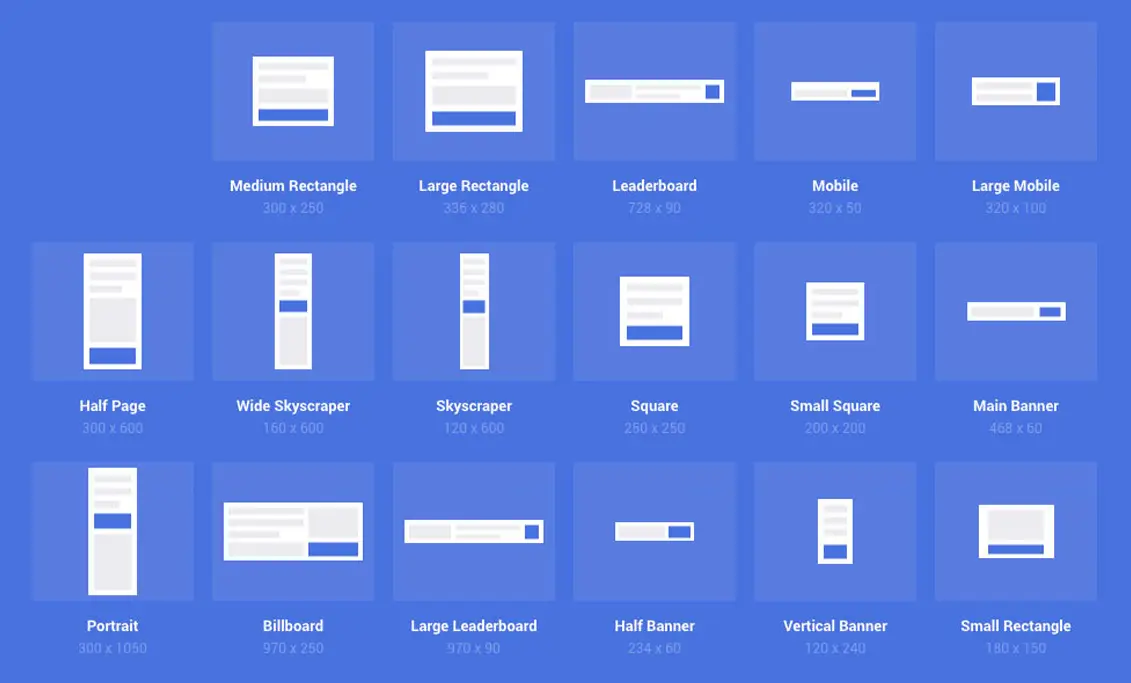
Considered Advertising banner sizes Diverse and numerous, and vary according to business needs and the requirements of the advertising campaign. Here are some common types of advertising banners in terms of size:
1. Leaderboard

Dimensions: 728 x 90 pixels
They are usually displayed at the top of the page and are used to display important messages and major promotions.
2. Medium Rectangle

Dimensions: 300 x 250 pixels
Usually used in the middle of the page or at the top on the side of the text, they are considered one of the most popular banners.
3. Wide Skyscraper

Dimensions: 160 x 600 pixels
Typically used at the top, right or left side of the page, they provide plenty of space to display advertising content.
4. Full Banner

Dimensions: 468 x 60 pixels
It is usually used at the top or bottom of the page, and provides ample space for displaying advertising messages.
5. Large Rectangle

Dimensions: 336 x 280 pixels
They provide a large space to display advertising content and are usually used in important areas of the page such as the top and sides.
6. Skyscraper

Dimensions: 120 x 600 pixels
Typically used at the top, right or left side of the page, they provide vertical space to display ads.
7. Button

Dimensions: 125 x 125 pixels
They are usually used on the right or left side of the page, and are considered small banners that do not take up much space.
It varies Banner sizes To meet the needs of brands and their advertising strategies, the appropriate size can be chosen according to the purpose of the advertisement and the target audience.
How do advertising banners work by the site owner and by advertisers?

The process of displaying advertising banners requires interaction between the site owner and advertisers, as each of them seeks to achieve specific goals. Here's how each of them works:
By the site owner
Providing advertising space
The site owner selects advertising spaces on his site to display advertising banners, such as the right or top side of the page.
Provide data
The website owner provides information about the target audience, expected ad clicks, and potential conversion rates.
Determine prices
The site owner sets the prices and models you can choose from, such as CPM, CPC, or monthly cost.
Negotiating with advertisers
He negotiates with advertisers and determines the details of the advertising campaign, including the duration, cost, and required advertising specifications.
Performance follow-up
It monitors the performance of advertisements and analyzes data to measure the effectiveness of the advertising campaign and improve it if necessary.
By advertisers
Choose appropriate sites
The advertiser chooses the sites on which he wants to display his ads, based on the site's audience and the content provided.
Banner design
He designs the advertising banner and prepares the message, images, and links to be displayed in the advertisement.
Setting the goal
The advertiser determines the advertising goals he wants to achieve, such as increasing sales or increasing brand awareness.
Model selection and negotiation
The advertiser chooses the appropriate payment model and begins negotiating with the site owner regarding the cost and terms.
Performance monitoring
The advertiser tracks the performance of his advertising campaign and analyzes the data to measure the effectiveness of the ads and achieve the set goals.
In this way, cooperation takes place between the website owner and the advertiser to offer Advertising banners Effectively and achieve the objectives of the advertising campaign.
Advantages and disadvantages of marketing through advertising banners

Advantages of advertising banners
Generate brand awareness: Advertising banners help attract the attention of the target audience and introduce them to the brand and its products or services.
Directing the audience to websites: Banner ads can help increase traffic to important websites or pages.
Enhance interaction: Advertising banners contribute to increasing interaction with the audience, such as clicks on ads and increasing the number of viewers.
Directing the target audience: Advertising banners can be targeted towards a specific audience group based on specific criteria such as age, gender, and interests.
Traceability and measurability: The performance of advertising banners can be easily measured using data analysis tools such as Google Analytics Which helps improve advertising campaigns.
Disadvantages of advertising banners
Ignore the audience: The audience may ignore advertising banners and not interact with them, which reduces the effectiveness of the advertisement.
Advertising Satisfaction: The public's exposure to too many advertising banners can lead to advertising saturation and reduce advertising effectiveness.
Block ads: Users can use ad blocking software to prevent banner ads from being displayed, which reduces the chances of interacting with ads.
Consistency with content: Advertising banners may not always be proportional to the site content, which may negatively affect the user experience.
Advertising cost: The cost of displaying advertising banners may be high compared to some other advertising styles, such as text ads.
Things that should be taken into consideration by advertisers and website owners

Here are some things that advertisers and website owners should pay attention to:
By advertisers
Target the right audience: Advertisers must understand their target audience well and choose advertising channels that reach these audiences efficiently.
Determine advertising objectives: Advertisers must set clear and specific goals for the advertising campaign, whether it is increasing sales or increasing brand awareness.
Attractive ad design: Advertisers must design advertising banners in an attractive and inspiring way to attract the audience’s attention and increase the chances of interacting with them.
Measure and analyze performance: Advertisers must constantly monitor the performance of their advertising campaigns and analyze data to measure success and improve performance in the future.
By website owners
Providing suitable advertising spaces: Website owners must provide advertising space that suits advertisers' needs and is compatible with the site's content.
Maintain user experience: Advertising banners must complement the user experience and not confuse it or impede access to the basic content of the site.
Setting prices appropriately: Website owners must set reasonable and appropriate prices for advertisements displayed on their site.
Dealing professionally with advertisers: Website owners must be cooperative and professional in dealing with advertisers and meeting their needs well.
Control harmful ads: Website owners should avoid displaying harmful or deceptive ads that may negatively impact the site's reputation and user experience.
This article was written via Magnet Team